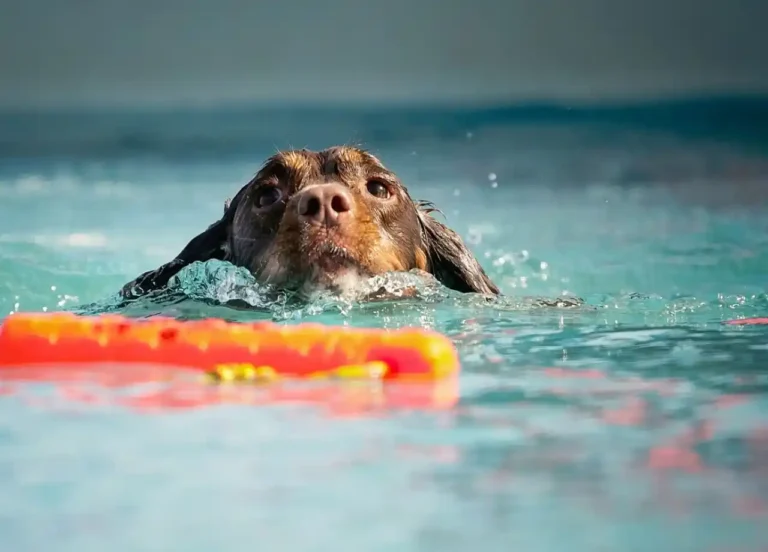
Watching a puppy discover water for the first time can be one of those moments you remember for years. Some puppies walk straight in as though they have been swimming their entire lives. Others stare at the water, touch it with one paw, and immediately decide they need considerably more information before proceeding.
At Animal Friends’ Pampered Paws, we believe that second reaction deserves just as much respect as the first. Swimming can be wonderful exercise, enrichment, and plain old fun for dogs, but puppies need a thoughtful introduction to water. Because swimming is part of what dogs can experience at our 14-acre property in Bealeton, Virginia, we place much more importance on safe, positive experiences around water than simply getting a puppy into a pool.
So, when can a puppy swim in a pool? There is no single birthday when every puppy suddenly becomes ready. Age matters, but vaccination status, physical development, water temperature, confidence, health, supervision, and the pool environment matter just as much.
How Old Should a Puppy Be Before Swimming in a Pool?
In general, very young puppies should not be treated like miniature adult dogs around a swimming pool. They are still developing physically, they tire quickly, and they may have more difficulty regulating their body temperature. A puppy that appears enthusiastic can become cold or exhausted surprisingly fast.
Rather than relying on age alone, we recommend looking at the whole puppy. Is your veterinarian comfortable with the puppy swimming? Has the puppy progressed appropriately through its vaccinations? Is the puppy healthy and physically strong enough for the activity? Is the water warm enough, and is there a safe, easy way for the puppy to get out?
Vaccinations deserve particular attention. Young puppies that have not completed the vaccination schedule recommended by their veterinarian may be more vulnerable to infectious diseases. The risk depends on where the puppy is swimming and what animals have access to that environment. Before introducing a young puppy to a shared pool or other communal dog environment, talk with your veterinarian about vaccination status and appropriate timing.
There is also an important difference between introducing a puppy to water and expecting the puppy to swim. A gentle introduction might mean standing near a shallow area, getting the paws wet, or calmly exploring water at the puppy’s own pace. That is very different from placing a puppy into deeper water and expecting instinct to take over.
Can Puppies Naturally Swim?
One of the most persistent assumptions about dogs is that every dog automatically knows how to swim. The phrase “dog paddle” probably has something to do with that belief.
Many dogs will instinctively move their legs when they enter water. That does not necessarily make them competent or confident swimmers. Frantic paddling, for example, can look like swimming when the dog is actually struggling to remain above water.
Breed and body structure of dog can make a significant difference. Dogs with short legs, heavy bodies, flat faces, or certain proportions may have a harder time keeping themselves comfortably positioned in the water. Even puppies from breeds famous for enjoying water should not automatically be considered safe swimmers.
Personality matters too. One Labrador Retriever may happily investigate every puddle on the property while another would prefer to observe from dry land. We do not think dogs should be forced to enjoy an activity simply because their breed has a reputation for it.
A puppy’s first experiences can influence how the dog feels about water later. Calm, controlled introductions give the puppy an opportunity to build confidence instead of simply reacting to an unfamiliar situation.
What Makes a Puppy Ready for Its First Swim?
A puppy that is ready for swimming should be healthy, energetic, comfortable with the environment, and able to move confidently on land. Veterinary guidance is particularly important for puppies with health concerns, orthopedic issues, breathing difficulties, recent illness, or other conditions that could affect exercise.
The environment needs to be ready too. Puppies should have an obvious, accessible exit from the pool. Stairs or a gradual entry can make it easier for a dog to understand how to leave the water. Before allowing a puppy to venture farther, we want the dog to become familiar with that exit.
Water temperature is another consideration people sometimes underestimate. Puppies can lose body heat relatively quickly, especially smaller puppies and those with thin coats. Shivering, slowing down, reluctance to move, or unusual behavior are reasons to end the session and get the puppy warm and dry.
The first swim should also happen when you have enough time to pay complete attention. Pool time with a puppy is not an activity to supervise from across the yard while doing something else.
How to Introduce Your Puppy to a Pool
Start by allowing your puppy to investigate without pressure. Let the puppy walk around the pool, sniff, watch the water, and become familiar with the surroundings. Curiosity is useful. Forcing the process is not.

Move toward shallow water when the puppy appears comfortable. Stay close and offer calm encouragement. If your puppy wants to retreat, allow it. You are trying to teach the puppy that water is predictable and safe, not that there is no escape from it.
When the puppy progresses into deeper water, stay within immediate reach and provide support as necessary. A properly fitted canine life jacket can provide additional buoyancy, particularly during early swimming experiences or for dogs whose body type makes swimming more difficult. A life jacket is a safety aid, however, not a substitute for close supervision.
Keep those first experiences short. Puppies often have plenty of enthusiasm but limited judgment about when they are getting tired. Ending a session while your puppy is still comfortable can be much better than waiting until exhaustion turns a positive experience into a frightening one.
Teach Your Puppy How to Get Out of the Pool
If we could convince every dog owner to prioritize one pool lesson, learning the exit would be high on the list.
A dog may enter a pool from one location and then become confused about how to get back out. Pool walls can look similar from water level, and an excited or frightened dog may continue paddling along the edge instead of locating the steps.
Show your puppy the exit repeatedly. Guide the puppy toward the stairs or safe exit from different nearby positions until getting out becomes familiar. Practice this under direct supervision rather than assuming the puppy will figure it out during an emergency.
This lesson remains important even after a dog becomes a strong swimmer. Confidence in water should never replace knowing how to leave it safely.
How Long Should a Puppy Swim?
For a puppy’s first experiences, think in terms of brief introductions rather than lengthy exercise sessions. Exactly how long a puppy should remain in the water depends on age, breed, physical condition, swimming ability, water temperature, and the intensity of the activity.
Swimming can be physically demanding. A dog that can run around the yard for quite some time may become tired much sooner while continuously paddling. Puppies also may not communicate fatigue in an obvious way until they are already worn out.
Watch the puppy rather than the clock alone. Slower movement, excessive effort, difficulty maintaining position, repeated attempts to leave, shivering, or a noticeable change in enthusiasm can all indicate that pool time should end.
We would much rather see a puppy finish a swim wanting another turn than stay in the water until the experience stops being enjoyable.
Pool Water and Puppy Safety
Swimming safely involves more than preventing drowning. Pool water itself deserves some thought.
Properly maintained swimming pools contain chemicals intended to keep the water sanitary. Dogs should not be encouraged to drink pool water. A few accidental laps while swimming are different from repeatedly using the pool as a giant water bowl, so keep fresh drinking water available nearby.
After swimming, rinsing your puppy with fresh water can help remove residual pool chemicals from the coat and skin. Dry the puppy thoroughly, paying attention to the ears and areas where moisture can remain trapped. If you notice persistent skin irritation, ear problems, coughing, vomiting, unusual tiredness, or other concerning symptoms after swimming, contact your veterinarian.
Pool maintenance matters as well. Chemicals should always be stored securely where curious puppies cannot reach them. Concentrated pool products can present a much more serious hazard than properly maintained pool water.
Never Leave a Puppy Unsupervised Around a Pool
A pool should be treated as a potential hazard whenever a dog can access it, regardless of how well that dog swims.
Young puppies are especially unpredictable. They can slip, jump after a toy, follow another dog, or investigate something before you realize what they are doing. Pool covers are not automatically safe surfaces either, particularly if an animal can fall onto or become trapped by the cover.
Physical barriers and controlled access can help prevent accidents, but active supervision remains essential whenever a puppy is around an accessible pool. Do not assume that because your puppy successfully swam yesterday, the puppy can safely handle the pool alone today.
Good swimmers can still become tired, frightened, injured, or disoriented. Water safety should remain a lifelong habit.
What If Your Puppy Is Afraid of Water?
Do not turn swimming into a battle.
A puppy that backs away, freezes, struggles, or repeatedly tries to escape is communicating something important. Give the puppy more distance and allow confidence to develop gradually. You can build positive associations around the pool without requiring the puppy to swim.
Some dogs need several introductions before they become comfortable. Others may never particularly enjoy swimming, and that is fine. There are plenty of other ways for a dog to exercise, play, and experience enrichment.
At Animal Friends’ Pampered Paws, we believe successful activities should account for the individual dog in front of us. Temperament, confidence, physical ability, and previous experiences all matter. A puppy does not need to prove anything by getting into the water.
Swimming Can Be Great Exercise, but Puppies Still Need Balance
Once a puppy is developmentally ready and comfortable in the water, swimming can add variety to an active lifestyle. It engages the body differently from running and playing on land, and many water-loving dogs find it enormously rewarding.
That does not mean more swimming is always better. Growing puppies need age-appropriate activity, adequate rest, and careful management rather than an adult dog’s exercise routine scaled down by a few minutes. Your veterinarian can provide guidance appropriate to your puppy’s breed, growth, health, and developmental stage.
Swimming should also be one part of a broader routine that includes social experiences, training, mental enrichment, rest, and ordinary puppy play. At our Bealeton facility, we see firsthand how differently dogs respond to different activities. Some are enthusiastic Water Dogs, while others would happily spend their time enjoying what our Nature Dog or City Slicker experiences have to offer instead.
The activity should fit the dog, not the other way around.
So, When Can Your Puppy Swim in a Pool?
There is no single age when every puppy is ready to swim. What matters more is whether your puppy is healthy, appropriately vaccinated for the environment, physically ready, and comfortable around water. If you are unsure, especially with a very young puppy or one with health concerns, check with your veterinarian first.
Keep early swims short and closely supervised. Make sure your puppy knows how to exit the pool, watch for fatigue or shivering, and never force a nervous puppy into the water.
At Animal Friends’ Pampered Paws, we have seen that dogs develop confidence around water at very different rates. Give your puppy time, keep the experience positive, and let safe swimming skills develop gradually.
.